
What the Freshfields Lab carve-out discussion admits about valuation, pricing and the limits of the traditional law firm model.
This week the Financial Times reported that senior Freshfields partners have been discussing whether to carve out Freshfields Lab, the firm’s legal AI unit, into a separate entity that could take outside investment or even list. The logic, laid out in an email exchange that reached a far larger audience than intended, was simple. Legal tech companies trade at 25 to 40 times revenue. A law firm does not. Keep the AI revenue inside the partnership and it is valued like legal fees. Put it in a vehicle of its own and it might be valued like Harvey or Legora.
Whatever becomes of the idea, the exchange is one of the most illuminating things I have read about law firm economics in years, not because of the deal but because of what its logic admits.
The admission
The market values the same work very differently depending on how it is packaged, sold and scaled. A document analysis tool used by associates on a billable matter earns an hourly rate and a realization percentage. The same tool sold to a general counsel earns a recurring license fee and a valuation multiple. The intelligence did not change. The business model did.
Why doing things differently is not optional
The traditional model prices inputs. That worked for fifty years because inputs were scarce and clients had no practical alternative. AI changes the first condition directly: a growing share of the inputs firms sell are becoming cheap. It changes the second indirectly: clients now have alternatives, including tools their own legal departments can license.
A firm that keeps pricing inputs will watch the arithmetic turn against it: fewer hours per matter, rate pressure on the work that remains, and a client who knows what the work costs to produce. The response cannot be to defend the hour harder. It has to be to price something else.
Price the value, not the effort
In our pricing methodology, fair value is a triangle: the client at the apex, you and the client’s next best alternative at the base, perception of benefit in the middle. Fair value is the benefit the client perceives, less the cost to acquire it, against that alternative.
The first pricing question stops being what the work cost to produce and becomes what it is worth to the client against the alternatives.
A legal AI product’s value to a general counsel is measured against what Harvey or Legora would charge and what the in-house team could do alone, not against the hours an associate would have billed. Hence the separate vehicle.
Most firms do not need a separate entity to apply the logic. The reframing itself points toward the fee structures that matter most: fixed fees tied to defined outcomes, subscriptions for ongoing advice, portfolio pricing across a book of matters, and success-based components where results are meaningful and measurable.
Notably absent are fee caps and blended rates. Those structures still tether value to time. They shift downside risk to the firm without a corresponding opportunity to share in the upside when the firm delivers greater value, greater efficiency or a better outcome.
Value creation has a sustaining life
The second lesson is about enterprise value, or more precisely, why most law firms create so little of it. Traditional partnerships distribute nearly all of their earnings each year. They retain little capital, build few transferable assets and own relatively little that an outside buyer could independently value.
Freshfields appears to have recognized that one part of its business worked differently: a unit built around proprietary tools, recurring revenue, data and scalable capability. Those attributes can support a valuation because they create value beyond the current year’s billings.
The lesson for firm leaders is not that every firm should spin out an innovation lab. It is that today’s investment choices determine whether the firm remains a stream of annual partner income or begins to build assets with enduring value. Proprietary workflows, knowledge products, reusable technology, matter data, scalable delivery models and client relationships that depend on institutional capability rather than individual partners can compound over time. Billable hours do not.
What this asks of leadership
The thread describes a managing partner putting serious personal work into a question most firms have not yet asked. That is the bar now. This is not a technology project for an innovation team or a pricing project for a pricing director. It is a change in what the firm sells and how it captures value, and it sits with the executive committee.
The firms that get this right will know where their value is created and who perceives it, price against the client’s real alternatives rather than their own cost, invest in what compounds, and move with the urgency Freshfields showed, because the window is real and it is not permanent.
Executive Transformation Framework
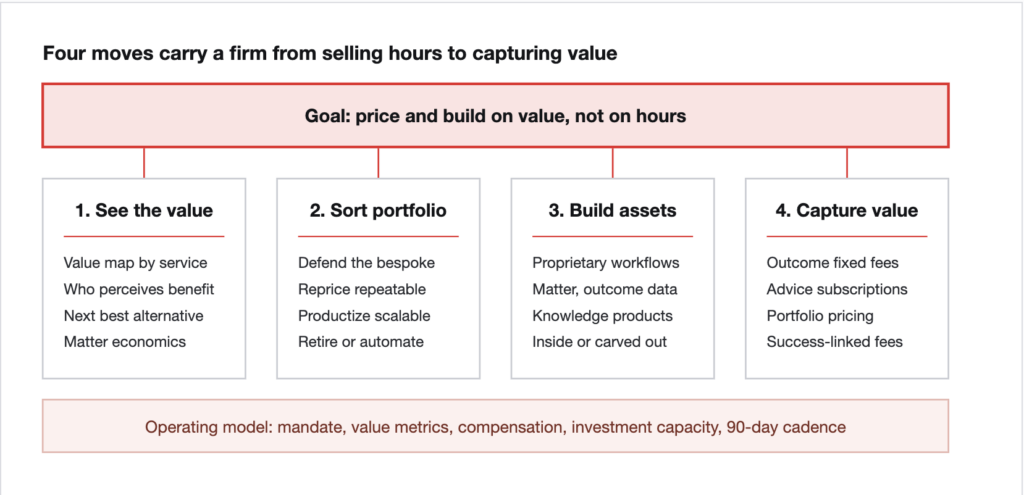
Four moves carry a firm from selling hours to capturing value
A starting structure for a leadership team ready to begin: four moves, in order, on top of an operating model that makes them stick. It sits alongside the Pricing Innovation Cycle (Discover, Design, Deploy, Distill, Drive): the cycle runs each pricing change, the framework decides which changes the firm should be making at all. The PDF holds the four moves, the portfolio sort, the operating model and a first 90 days plan.
Download
Executive Transformation Framework (PDF)
Two pages: the four moves, the portfolio sort, the operating model and a first 90 days plan.
OPEN THE PDFMark Medice, Principal, LawVision · mmedice@lawvision.com
Posted In