
A September 25 Financial Times article highlights the growing pressure on law firms to reconsider the billable-hour model as artificial intelligence reduces the time required for certain legal tasks.
The article reports that major clients, including Goldman Sachs, Morgan Stanley and Citigroup, expect their law firms to share the benefits of AI-driven efficiencies. Revolut is also reconsidering its traditional law-firm panel relationships, placing greater emphasis on quality and value. Meanwhile, approximately 80% of the work offered through legal-procurement platform Persuit now uses alternative fee arrangements rather than conventional hourly billing.
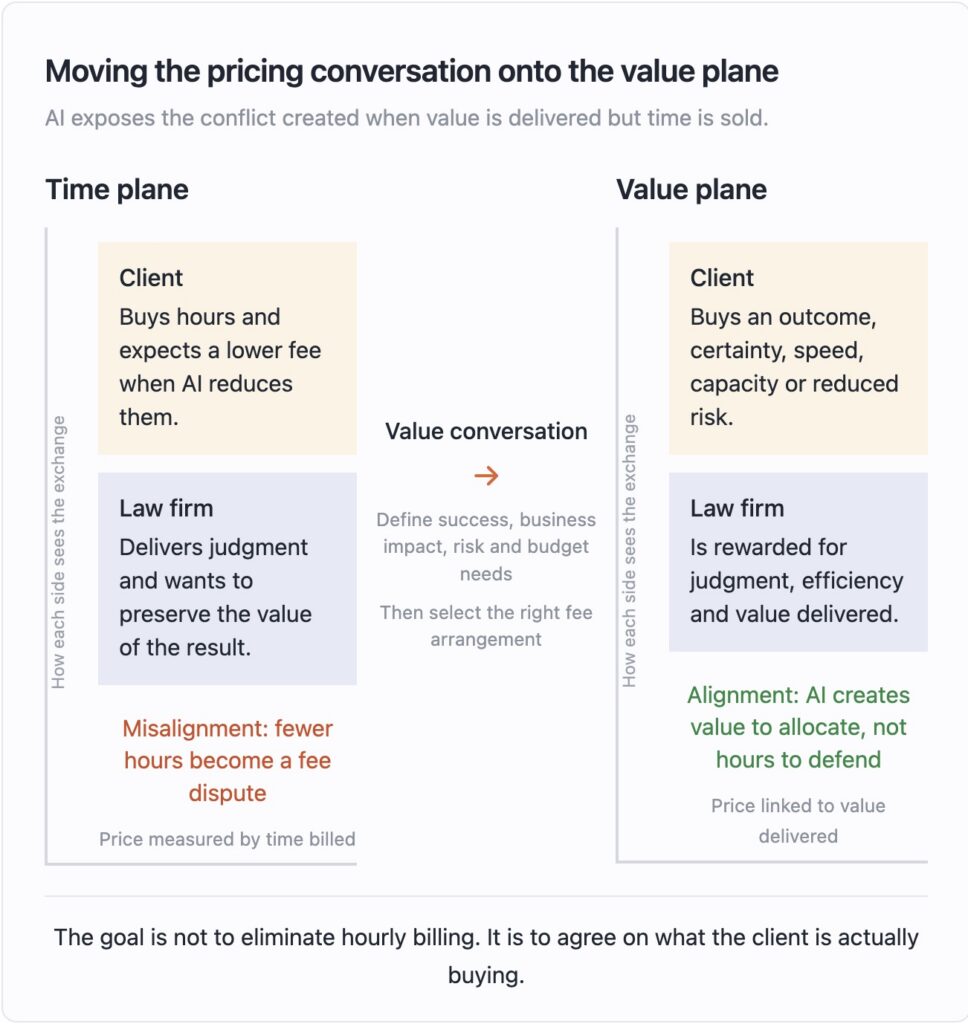
These developments expose a longstanding tension between law firms and their clients: Are clients buying lawyers’ time, or are they buying value?
Most clients experience legal services through the billable hour. Their invoices are organized around hours, timekeepers and billing rates. When AI reduces the time required for research, document review or drafting, clients reasonably expect their legal fees to decline.
Law firms see the relationship differently. They believe clients are buying judgment, experience, risk management and successful outcomes. From the firm’s perspective, completing an assignment more efficiently does not necessarily make the result less valuable. Faster delivery, stronger analysis and reduced risk may increase the value provided.
Both perspectives are understandable. The difficulty is that the billable hour reinforces the client’s view. Law firms cannot present time as the primary unit of purchase and then be surprised when clients expect to benefit from technology that reduces that time.
What Should Law Firm Leaders Do?
Law firm leaders should engage clients in a direct conversation about value. Instead of limiting pricing discussions to rates and discounts, they should explore what the client is trying to accomplish.
Does the client want budget certainty, faster resolution, reduced risk, greater internal capacity or a particular business outcome? How will success be measured, and what is that success worth?
It also helps to be precise about what AI has changed. Sometimes AI delivers the same result in less time. Sometimes it makes a result practical that wasn’t before, such as reviewing every contract rather than a sample. The first is an efficiency gain; the second is a new capability. They call for different pricing.
Those conversations create the foundation for fee arrangements that reward value delivered rather than time accumulated. Depending on the work, firms might use:
- Fixed or phased fees
- Portfolio pricing
- Subscription arrangements
- Success or performance components
- Hybrid structures combining hourly rates with defined incentives
- New AI-enabled deliverables priced on their value, not on the hours they replace
Not every matter is suitable for an alternative fee arrangement, and these approaches will not eliminate every disagreement over AI and legal fees. They can, however, move the firm and client onto the same value plane.
When both sides understand what is being purchased, how success will be measured and how the benefits of AI-enabled efficiency will be shared, the pricing conversation becomes more constructive.
AI makes this issue more urgent, but the underlying challenge is not new. Law firm leaders should not wait for clients to dictate how AI savings will be handled. They should measure what AI is actually changing in their work, initiate the discussion, define the value their firms deliver and develop pricing structures that align the firm’s economics with the outcomes clients actually care about.
Start With One Matter
The shift from hours to value doesn’t have to begin firmwide. Take one work type or matter and work through three questions in order:
- Does AI change the economics of this work? If not, price as you do today and revisit as the tools improve.
- Is the work now predictable enough to commit to a price? If so, move to an alternative fee based on the AI-adjusted baseline. If not, stay hourly but re-baseline the budget.
- Which lever shares the value with the client? Pass efficiency through, fix or cap the fee, price a portfolio, hold the rate, add a success component, reinvest the saved time, or price the new deliverable.
Free Pricing Tool
The AI Pricing Decision Tree
All three questions on one page, with the levers firms most often miss, the kind of client each lever fits, and the guardrails that keep any fee defensible.
PDF · 1 page
Mark Medice, Principal, LawVision · mmedice@lawvision.com
Posted In