
Thomson Reuters’ latest report shows firms raising rates at record levels while demand grows and clients keep paying. The question for law firm leaders is what to do with that strength while it lasts.
To download this blog in PDF form, click here.
What the report finds
The Thomson Reuters Institute’s Law Firm Rates Report 2027: The AI impact you may not have been expecting (October 28, 2026) gives the industry one of its clearest looks at pricing. Its key findings:
- Prices hit a record. Am Law 100 worked rates rose 9.7% through June 2026 and all segments rose 7.1%. The average US standard rate is about $800 an hour, $720 after initial discounts.
- The segments split. For the first time in nearly two decades, midsize firms slowed (5.4%) while the largest pressed harder.
- Demand is back, driven by risk. Hours rose 2.8% as regulatory change, technology and geopolitics sent clients to counsel with work they cannot defer.
- Clients are still paying. Only the Am Law 100 gave up real ground on realization, about 1.5 points.
- Costs are rising, led by technology. Per lawyer, direct expenses grew 5.3%, overhead 5.5%, and technology and KM 10.3%. Profit per lawyer still climbed.
- The pyramid got deeper. Associates per equity partner rose to 1.30 from 1.13 before the pandemic.
- AI is arriving as demand, not efficiency. Clients need help with AI financings, licensing, IP, privacy and regulation, but efficiency gains inside firms are hard to find; 85% of professionals say their firm does not track AI’s return or do not know. Firm spending shifted when Microsoft Copilot became available (November 2023) and when the tariffs took effect (April 2025).
- A second half is coming. Today’s strength pays firms to manage their clients’ disruption. The next phase begins when the technology reaches the firm’s own work.
Figures are Thomson Reuters data through June 2026 unless noted.
What matters most
From strong results to stronger foundations
Read together, these findings describe a market with real pricing power, but little change in how firms price, measure or deliver their work. From where we sit, three ideas matter most, and each builds on the one before.

Key Point 1 · Fair Value
1. Know fair value, and achieve it
It starts with knowing fair value: what the work is worth to the client against the next best alternative. Record rate growth proves firms can raise prices, not that each price reflects the value delivered.
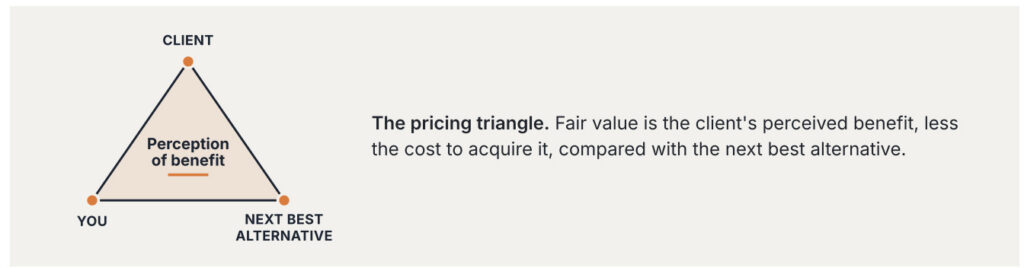
Then achieve it. The drop from about $800 to $720 happens before a single hour is billed. Much of that discount is habit. Achieving fair value means setting rates with intent and holding to them where they are earned.
Key Point 2 · Profit Foundations
2. Build the profit foundations to support it
Fair value is set by the market. Making it work depends on margin. It will be very hard to price beyond time without knowing your margins. The report measures rate growth against consumer inflation, but firm costs run on compensation, real estate and technology. Set worked rate growth of about 7.1% against direct and overhead cost growth of roughly 5.5% per lawyer, and the margin picture becomes clearer.
Many firms are not yet measuring profit where pricing decisions are made. From LawVision’s 2026 Flash Profitability Survey:

The industry is evolving, but slowly. Half of firms give profitability no weight in partner pay. Profit metrics belong inside service design: model margin under hourly, fixed fee and staffing scenarios before launch, then track the results.
Innovation without the economics attached is a guess.
3. A method for pricing beyond time
Key Point 3 · Beyond Time
My recommendation: start exploring how to price to value rather than time. As AI makes work faster and more predictable, hourly pricing hands that efficiency to the client. The task is to replace the hour as the basic economic unit wherever the work allows.
Before a matter type can carry a fee beyond the hour, it must be definable, repeatable and modelable. LawVision’s Pricing Readiness Assessment scores seven conditions, 0 to 2 each, for a total of 14:
- A clearly defined economic unit
- Observable complexity factors
- Standard scope and exclusions
- A repeatable delivery workflow
- Defined quality standards
- A modelable cost distribution
- A client-facing value proposition
| 0 to 5: Strategic hourly | 6 to 9: Scoped and structured | 10 to 14: Fixed fee or productized |
| Align rates to fair value; define the unit and scope. | Phase fixed fees or collared budgets. | Menu, portfolio or subscription pricing. |
Score the portfolio and start with the two or three highest-scoring matter types, model the profit, and pilot with clients open to the conversation.
Looking ahead
Use the first half well
The report frames this AI era in two halves. In the first, firms profit from their clients’ disruption: the financings, licensing fights and regulatory work that AI and the tariffs create. In the second, AI reaches the firm’s own work, and the hour comes under pressure.
The first half buys time. Firms that use it to price to fair value, build the profit foundations to support it, and start moving beyond the hour will be ready when the second half arrives.
LET’S TALK
Rethinking pricing for an AI world?
A short working session is often enough to find the two or three places to start.
To download this blog in PDF form, click here.
Posted In