
The return on AI will not come from the tools. It will come from how firms price the work the tools change.
A new survey of 396 enterprises by Mavvrik and Benchmarkit, highlighted by Apollo’s Torsten Slok, puts numbers on it. Only 11% of organizations forecast their AI spending within 10% of actual, down from 15% a year ago. 62% say an unexpected AI cost changed a business decision, and one in four delayed or canceled an AI initiative. 63% see gross margin fall 6 to 15 percentage points. We are still waiting for the ROI, and costs keep surprising us.
Law firms sit on both sides of that survey. They are AI buyers with the same forecasting problem, and they sell to clients watching AI eat into their own margins. Those clients will expect AI’s efficiency in their invoices now, not when the firm’s investment pays back. Meanwhile, under a time-based model, the more capable a firm becomes, the more it is penalized.
The answer is to move pricing from habit to design. Four moves matter most.
Build a real pricing system
A pricing system is more than a pricing manager. It gives the firm a disciplined way to understand what its work is worth, how that value varies by matter and client, and how to capture an appropriate return.
Its core elements include:
- a clear pricing position for the firm
- lawyers who understand the value of their work and are equipped to price for it
- market intelligence on what clients will pay and economic intelligence on what the work costs to deliver
- feedback loops that compare pricing decisions with actual results
- accountability for outcomes
- the ability to evolve pricing as delivery models and client value change
Pricing is one of the most powerful drivers of law firm profitability, and margin is what connects pricing discipline to investment capacity. That becomes especially important in an AI environment. Firms cannot make sound decisions about where to invest, what to automate, or how aggressively to scale without understanding matter-level economics: margin by type of work, realization, staffing, and where AI is most likely to change the cost of delivery.
That leads to a foundational question every firm should be able to answer with evidence:
Where are we still pricing by habit rather than by design?
Price to value, and keep innovating
Every hour AI removes raises a fundamental question: who keeps the gain? If firms do not answer that question deliberately, clients and procurement teams will answer it for them. This does not have to be a zero-sum game, but it does require firms to take an active posture: make the value visible, differentiate the work, and earn a return on what sets the firm apart.
The hourly model still has a place where work is uncertain, bespoke, or reactive. But it becomes less compelling when the work is defined, repeatable, or increasingly accelerated by AI. That is where firms should begin experimenting with fixed fees, subscriptions, portfolio pricing, and hybrid models.
Caps, blended rates, and volume discounts can serve as useful transitional tools, but they do not fundamentally change the economics. They still define value primarily through hours and rates. The larger opportunity is to move beyond pricing time more efficiently and toward pricing the value of the work itself.
From there, firms should push further, especially in the practices where their reputation, expertise, and market position already command a premium. The goal is not simply to preserve today’s economics in an AI-enabled world, but to rethink how the firm creates, communicates, and captures value.
Stand up legal service design teams
On its own, an AI tool is simply another cost. The economic return comes from changing how the work gets done. Firms must redesign the workflow around the technology, understand how staffing and effort change, measure the new economics, and then rethink how the work should be priced. Without those steps, AI may make lawyers faster without materially improving the firm’s economics.
That is why AI innovation cannot sit solely with the technology team. It requires a standing collaboration among pricing, knowledge management, technology, finance, and practice leaders. Together, they need to identify the right use cases, redesign the work, measure what changes, test new pricing approaches, and evaluate the results.
This is not a one-time exercise. It is a continuous pricing innovation cycle: identify an opportunity, redesign the work, measure the economics, reprice it, learn from the outcome, and repeat. Just as important, firms need to build with scale in mind. The largest gains will come not from isolated pilots, but from taking what works and extending it across matters, clients, practices, and eventually the enterprise.
The objective is to move from experimentation to repeatability, and from repeatability to scale. That is where AI can begin to produce meaningful gains in margin, capacity, consistency, and client value. The firms that build the operating discipline to scale successful models will be in the strongest position to convert AI from a technology investment into a durable economic advantage.
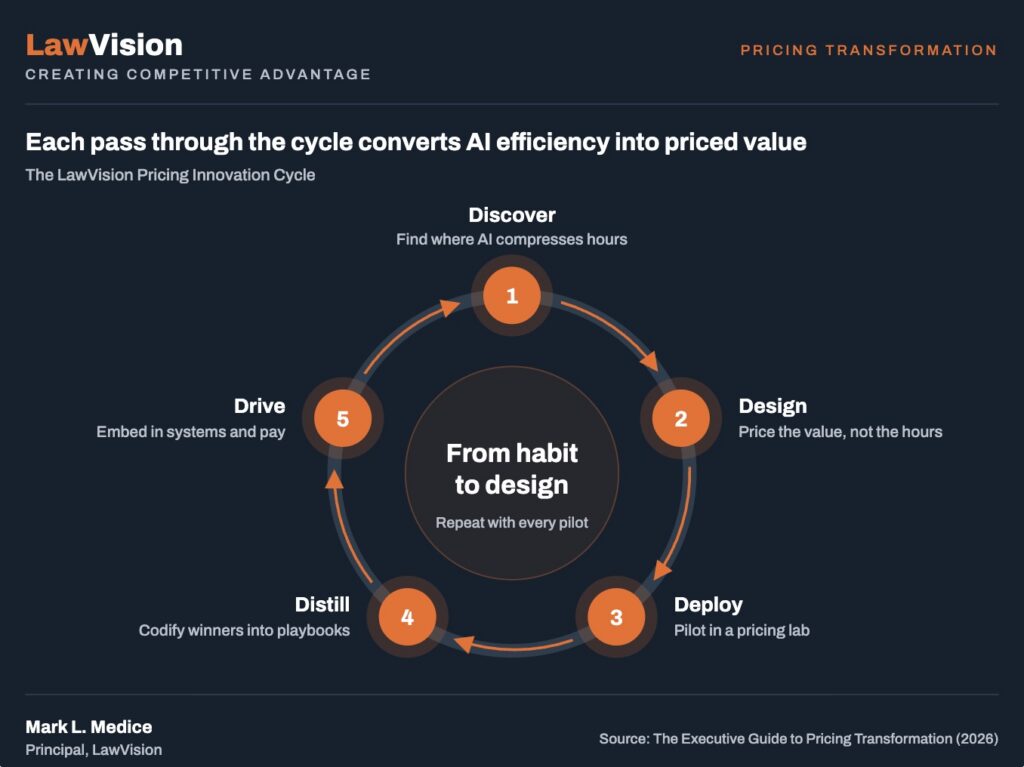
Firms that buy tools without redesigning the work are the ones missing their forecasts and watching margins shrink.
Make room for learning (and mistakes) in pursuit of change
AI transformation will not follow a straight line. Some pilots will underperform, cost more than expected, or reveal flaws in the pricing model. The answer is not to retreat, but to learn quickly and improve the design. A fixed fee that misses its target should become a source of insight about scope, staffing, workflow, and risk, not a reason to abandon the model.
That also requires aligning incentives with the behavior the firm wants. If compensation rewards only hours and revenue, partners will naturally hesitate to embrace approaches that reduce time or introduce economic uncertainty. Firms should place greater weight on margin, realization, client outcomes, and successful innovation.
The objective is disciplined experimentation: test selectively, measure rigorously, absorb small misses, and refine quickly. Firms that create room to learn will be far better positioned to capture the long-term value of AI than those that wait for every new model to be proven before they act.
The bottom line
The full payoff from AI may still be years away, but the pricing choices that shape how firms compete are being made now. Firms that delay building stronger pricing capabilities risk more than simply leaving money on the table. They may compress margins, weaken differentiation, underinvest in new delivery models, or fall behind firms that are better at converting AI-enabled efficiency into client value and economic performance. The firms best positioned for what comes next will build real pricing systems, price with a clearer understanding of value, redesign the work, and create room to test and learn.
Pricing is leadership. AI simply raises the stakes.
Source: Mavvrik and Benchmarkit, 2026 State of AI Cost Governance Report (n = 396, April to May 2026), as cited by Torsten Slok, Apollo, “AI Spending: Waiting on ROI, Watching the Bill,” October 14, 2026. Methodology: LawVision, The Executive Guide to Pricing Transformation (2026).
Posted In