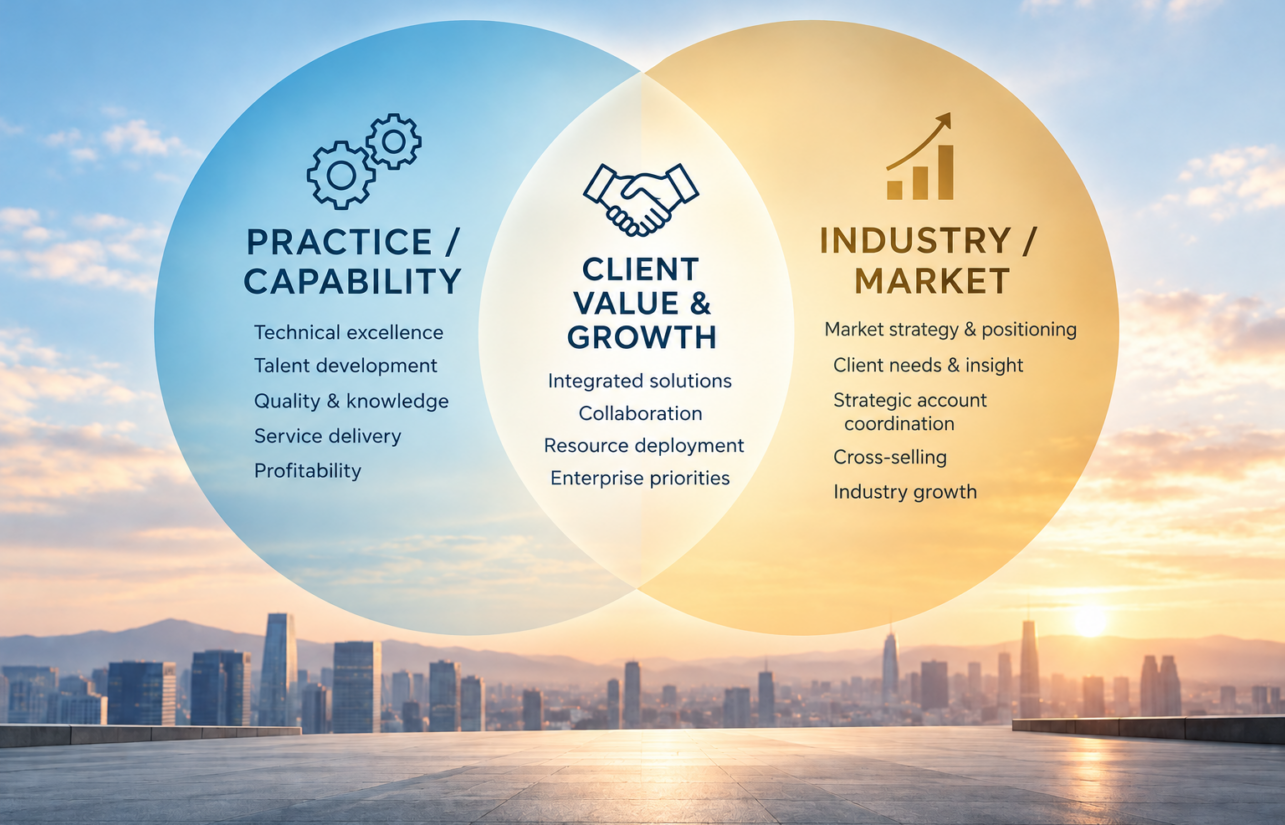

Organizational design should enable strategy, not merely describe structure
Law and consulting firms spend enormous amounts of time developing strategy: which markets to pursue, which clients to prioritize, where to invest, what capabilities to build, and how to differentiate themselves. Yet one of the most important questions often receives far less attention:
Is the firm organized in a way that enables the strategy to succeed?
Organizational structure is sometimes treated as an administrative issue—boxes on an organizational chart, titles for group leaders, and decisions about where professionals “belong.” In reality, the organizational model is one of the primary mechanisms through which a professional services firm executes its strategy.
The right model can increase collaboration and engagement, sharpen client and market focus, improve talent deployment, accelerate decision-making, and create greater accountability for growth and profitability. The wrong model—or a model that exists primarily on paper—can reinforce silos, create competing priorities, obscure accountability, and make even a sound strategy difficult to execute.
And as law and consulting firms become larger, more sophisticated, more multidisciplinary, and more focused on industries and integrated client solutions, getting the model right becomes increasingly important.
There Is No Single “Right” Organizational Model
Professional services firms generally organize around one or more dimensions: practices or capabilities, industries or sectors, clients or accounts, and geography. Each dimension serves a different purpose.
In most law firms, practices remain the primary dimension of management. Practice groups are often the professional “homeroom” for lawyers and are central to talent development, staffing, quality, knowledge management, financial performance, and leadership accountability. At the same time, many firms increasingly go to market by industry because clients experience their problems through an industry lens rather than through the firm’s internal practice structure.
Most full-service consulting firms use capability or service line as their primary dimension, paralleling law firms’ focus on practice areas. Other consulting firms organize primarily around industry or sector. Consulting firms may place more management authority in industry, capability, geography, or account structures depending on their strategy and heritage. The key point is not that one model is inherently superior. It is that the organizational model should reflect how the firm creates value and executes its strategy – including how it engages and inspires its professionals.
The challenge is that sophisticated professional services firms need multiple dimensions simultaneously. That is why the vast majority of firms operate some form of matrix organizational structure or model, even if they do not call it one.
What Does a Matrix Model Actually Mean?
A matrix recognizes that a professional may legitimately belong to more than one organizational dimension. A health care regulatory lawyer may have a professional home in a regulatory practice while also participating in the firm’s health care industry group. A cybersecurity consultant may belong to a technology or risk capability while serving clients across financial services, health care, and consumer products.
At its simplest, the matrix distinguishes between two different management questions:
- Practice/Capability: What expertise do we need, how do we deliver it exceptionally well, and how do we develop, deploy and engage our people to work together and achieve goals together – versus primarily as individuals?
- Industry/Market: Where should/can we compete, how are the markets changing, what do our clients need and want, and how do we grow?
For many law firms, this does not mean transferring primary management authority from practices to industries. It means making the industry go-to-market dimension sufficiently real to accomplish its purpose. The value of the matrix lies at the intersection: combining deep sector knowledge with the right expertise to solve client problems and pursue opportunities across traditional boundaries. However, a very small but growing number of law firms are making industry the primary dimension. This can work when lawyers can realistically be assigned to one, or at most two, industry groups—for example, a “major” and a “minor.” When they are willing to do that, industry as a primary dimension can be highly effective. But, it typically still needs a secondary dimension of practice/capabilities to ensure effective risk management, quality control, training, mentoring and development, to name a few.
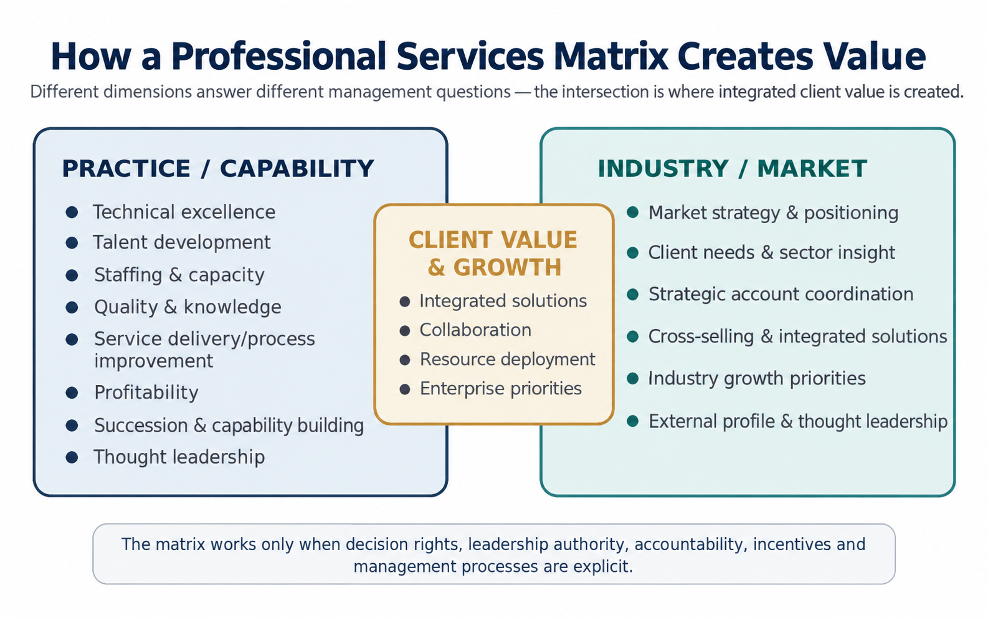
Figure 1. A matrix separates professional/capability management from market-facing industry leadership while connecting both around client value and growth.
The Matrix Can Also Create Confusion
Matrix organizations sound attractive because they promise the advantages of multiple structures. Poorly designed matrices, however, can produce the opposite result.
Who sets strategy? Who controls budgets? Who determines hiring priorities? Who is accountable for revenue growth? Who manages utilization and workload? Who owns strategic client relationships? Who evaluates professionals? What happens when the priorities of an industry leader and a practice leader conflict?
If the answer is simply “both,” the organization may have created shared involvement without clear accountability.
This is one of the most important lessons in organizational design: a matrix is not created simply by putting people into two groups. An effective matrix requires explicit decision rights.
For example, industry leaders might have primary responsibility for industry strategy, market positioning, strategic account coordination, cross-selling, client feedback, and industry growth initiatives. Practice or capability leaders might have primary responsibility for technical excellence, recruitment and integration, talent training, mentoring and development, staffing and capacity, quality, succession, and the economics of the work. Firm leadership typically retain responsibility for enterprise-level capital allocation, compensation, governance, and major strategic priorities.
The exact allocation will vary by firm – and should, based on the firm’s strategy and culture. What matters is that people understand who leads, who decides, who contributes, and who is accountable for each part of the leadership and management matrix.
Structure Should Follow Strategy
One of the biggest mistakes firms make is beginning organizational redesign by debating boxes: How many groups should we have? Where should this person report? Should this specialty be its own group?
Those questions matter, but they should come later. The first question should be: What are we trying to accomplish as a firm?
If the strategy depends heavily on industry specialization and integrated solutions, the industry dimension needs meaningful leadership, resources, information, and accountability – even if it remains secondary to practices. Industry may become the primary dimension if lawyers can realistically fit into one, or at most two, industry groups and that structure best supports the firm’s strategy. Or it may remain secondary but be highly empowered through clearly defined decision rights. If competitive advantage depends primarily on highly specialized technical expertise, practice or capability leadership may appropriately remain dominant. If a relatively small number of institutional clients generate a substantial portion of revenue, client teams, or strategic account teams as they are often called, may deserve a stronger role.
The organizational model should be designed to execute the strategy—not inherited from history.
Beware of the “Primary Versus Secondary” Problem
Many firms say they operate a matrix, but one dimension is clearly primary and the other largely advisory. There is nothing inherently wrong with that. In fact, clarity about which dimension has primary authority may be preferable to pretending that two dimensions are equal when they are not.
The problem arises when a firm declares, for example, that industries are strategically critical but gives industry leaders little authority, no meaningful budget, limited access to information, and no accountability for results. The title says “leader.” The operating model says “coordinator.”
A secondary dimension in a matrix needs enough decision rights, resources, management information, and leadership support to accomplish the objectives assigned to it. Otherwise, the matrix exists primarily on the organizational chart.
The Keys to Success Apply to Almost Any Model
Whether a firm chooses a practice-led model, an industry-led model, a geographic structure, a client/account model, or some form of matrix, several principles consistently distinguish effective organizational models.
1. Clear purpose – People need to understand not only what the structure is, but why it exists. What strategic problem is the model designed to solve? What should become easier or better because of it?
2. Clear roles and decision rights – A list of leadership responsibilities is not enough. Firms need clarity about who recommends, who decides, who executes, who must be consulted, and who ultimately owns the result.
3. Real leadership authority – Holding leaders accountable for outcomes without giving them sufficient authority is a recipe for frustration (if not worse, failure to achieve the strategy). Leaders need access to the information, resources, budgets, and leadership support required to perform their roles.
4. Meaningful accountability – Leadership positions should not be honorary titles. Goals should be specific, measurable where possible, and reviewed regularly. Accountability can include revenue growth, strategic clients, cross-selling, profitability, talent development, utilization, innovation, succession, collaboration, or execution of firm or group strategic initiatives. This often means firm leaders setting annual goals with each matrix leader and meeting throughout the year to assess progress. And in law and consulting firms, leaders are not the only ones accountable. All “owners” need to invest meaningful “investment time” in executing group and firm priorities—not just their individual business development.
5. Aligned incentives – A firm cannot ask professionals to collaborate across boundaries while rewarding them primarily for protecting their own clients, practices, or revenue. Compensation, origination credit, performance evaluation, leadership recognition, role modeling, and promotion systems all send powerful signals about what the organization actually values.
6. Management information – Leaders cannot manage what they cannot see. Effective group leaders need the right information on financial performance, clients, pipeline, workload, capacity, talent, pricing, profitability, and other relevant metrics.
7. Strong management processes – Structure alone does not produce results. Business planning, engaging meetings that build trust among members, budgeting, talent reviews, client planning, performance management, succession planning, innovation, knowledge sharing/management, and regular leadership reviews are the operating mechanisms that make the structure real.
8. Collaboration across boundaries – Every organizational structure creates boundaries. Practices can become silos. Industries can duplicate resources. Offices can become isolated. The model must deliberately create mechanisms that connect those boundaries rather than assuming collaboration will occur naturally.
9. Change management and buy-in – Professionals need to understand how a new model will affect them: Where do I belong? Who evaluates me? Who controls staffing? What happens to my existing group? How will compensation be affected? Who makes decisions when leaders disagree? These are legitimate operating-model questions. Firms should answer them as changes are rolled out so they do not add unnecessary uncertainty or destabilize the firm.
10. Willingness to evolve – No organizational model should be permanent. Markets change. Client needs change. Firms grow. New capabilities emerge. Technology—including AI—is changing how professional work is performed, staffed, priced, and managed. The model should evolve with the strategy.
The Organizational Chart Is Only the Beginning
Perhaps the most important lesson is that organizational design is not primarily about drawing boxes and lines. The organizational chart tells people where groups sit. The operating model determines how the firm actually works.
That includes who makes decisions, how resources are allocated, how professionals are deployed, how leaders are evaluated, how conflicts are resolved, how performance is measured, and how the firm converts strategy into action.
For law and consulting firms, this distinction is especially important because professionals often operate with significant autonomy. A structure that depends solely on voluntary coordination may work when a firm is smaller, but it becomes increasingly difficult as the organization grows in size, complexity, geography, and breadth of services.
The strongest organizational models balance professional autonomy and enterprise accountability. They preserve the expertise, entrepreneurship, and client relationships that make professional services firms successful while creating enough structure to enable the organization to operate as an integrated enterprise.
The ultimate test of an organizational model is not whether it looks elegant on paper. It is whether it helps the firm answer several practical questions: Are we closer to our clients? Are we making better decisions? Are we collaborating more effectively? Are our people fully engaged and committed? Are we deploying our talent and resources more strategically? Are our leaders truly accountable? And, most importantly, are we better able to execute our strategy?